Showing posts with label volcano. Show all posts

Tuesday, August 28, 2012

Mount Hibok-Hibok, a Natural Monument in Camiguin

Mt. Hibok-Hibok

Mt. Hibok-Hibok is in the volcanic island of Camiguin off the northern coast of Mindanao in the Philippines. It is listed by the Department of Environment and Natural Resources (DENR) of the Philippines as one of its protected areas, and together with Mt. Timpoong also in Camiguin is included in the list of natural monuments of the country.   A natural monument is a relatively small area which is protected by the government because of its naturally significant features that are of interest to the people living in the area and also to the people at large.                                                                                                   

Mt. Hibok-Hibok
Mt. Vulcan
The only active volcano of Camiguin, Mt. Hibok-Hibok is a composite or stratovolcano and a dome complex that has a height of 1,332 meters and a base diameter of 10 kilometers. It has three craters that are sites of eruption: Kanangkaan-1948, Itum – 1949 and Ilihan- 1950. The inactive or dormant volcanoes include Vulcan, Mambajao, Guinsiliban, Butay, Uhay, Campana, Carling, Guinsiliban,  Minokol and Tres Marias. Active volcanoes are those with historical eruption while inactive or dormant volcanoes may start eruption with little warning, such as Mt. Pinatubo in 1991.                                                                                                                 
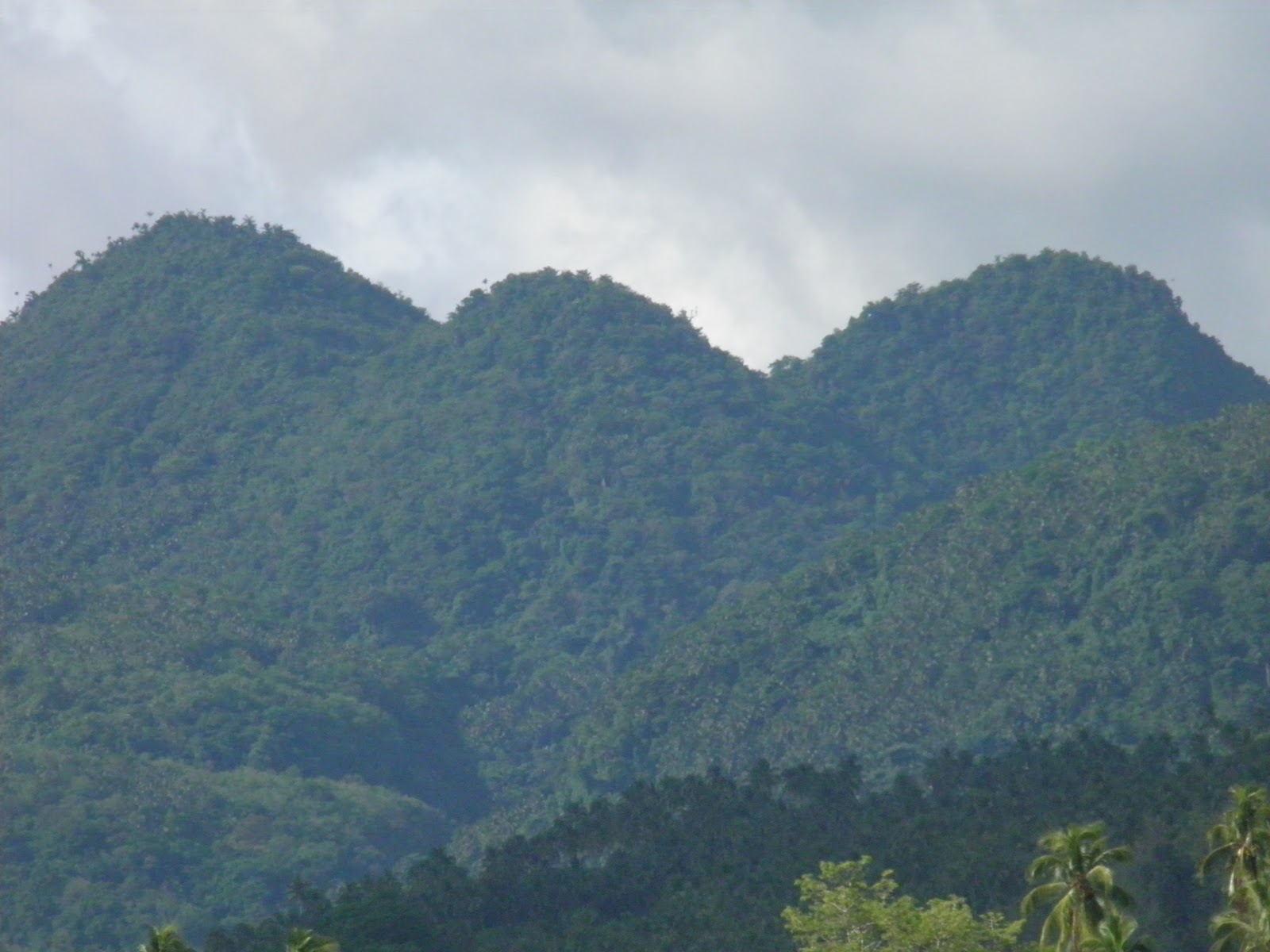
Mt. Tres Marias
Early eruptions occurred in 1827 and 1862. And these were followed almost a decade later. In February 16, 1871 there were rumblings in the earth accompanied with earthquakes. The lava of Mt. Hibok-Hibok instead of issuing from a central vent poured along a vertical fissure that extended for several distances across the land surface. The thick viscous lava solidified and accumulated and gradually formed into a mountain reaching a height of 590 meters.   

On May 13, 1871, Mt. Vulcan, the new mountain, exploded.  The explosion was accompanied by shower of rock, dust and ashes. Destruction was complete within a radius of 3 kilometers from the explosion of the new volcano mountain and buried to the ground houses, churches and other structures and submerged in sea water a portion of a ground area.                                                                                        

In 1897, Mt. Hibok-Hibok emitted white sulfuric vapors and damaged farms on the island. In 1902, the volcanic activity was only solfataric. In 1948, there was very little damage to the eruption. But in 1949, there were 79 deaths due to landslide. The most violent eruption was On December 4, 1951. There were avalanches of lava at 800 degrees Celsius. Gasses of carbon dioxide, hydrogen, carbon monoxide and sulfur dioxide were spewed into the air and there was formation of glowing cloud of dust. The pouring boiling lava fell down tree and charred houses, animals and people along its path. Mudflow of lava destroyed 19 square kilometers of land particularly in Mambajao and about 3,000 were killed.    

The volcanic eruptions terrified the people of the island so that a great number of them migrated to neighboring places of Cagayan de Oro, Misamis Oriental and Bohol.  Before eruption the population of the island was 69,000. After eruption it was reduced to 34,000.         


Today one can see the trace of the devastation caused by the 1871 eruption. There are the ruins of the old church at Guiob, the new name of the place of the destroyed village. Just several distances away from it was the cemetery that was consumed by the sea as a result of that catastrophic event. In 1983 a cross marker was built right in the location of the old sunken cemetery. That structure along with the ruins serves also as monuments to the catastrophic event that destroyed an old colonial town.          

A view of Mt. Vulcan in White Island
The locals call Mt Vulcan as “Daan Vulcan” or “old Volcano” which is a misnomer because the fact is that it is the youngest volcano of Camiguin which was born with the explosion of Mt Hibok-Hibok. Mt Vulcan is a parasitic dome of Hibok-Hibok and is still considered a part of it.                     

Beyond the destructive power of Mt. Hibok-Hibok, there arise from its volcanic activity beauties and wonders of nature. There are six hot springs that issue from the volcano. Hot spring occurs when magma heats up water stored in cracks in rock. The water returns to the surface as hot spring. In addition to the hot springs there are also cold springs and soda water springs. These enjoyable natural spots provide rest and relaxation not only to the people in Camiguin but also to people in other parts of the Philippines and the world.                                                                                                                                                             

Mt Hibok-Hibok is an ideal destination for hiking and mountain climbing to reach the summit of the volcano with Ardent Hot Spring as the starting point. Along the way, the hikers or climbers navigate the different terrains and see the flora and fauna that are indigenous to the island. Reaching the summit, they can see the White Island, the eastern coast of Misamis Oriental, and the islands of Siquijor and Negros that lay amidst the backdrop of the breathtaking view of the sea.                                                                                                                                                      

One can reach the summit of Mt Vulcan through the Way of the Cross. Catholic faithful usually climb the steps of the 14 Stations of the Cross to commemorate the passion of Christ’s crucifixion during the Holy Week. Reaching the last station will bring the devotee to the summit of Mt Vulcan.   

Mt. Hibok-Hibok (left) and Mt. Vulcan (right)
Camiguin Island is one of the major tourist destinations of Northern Mindanao.  From Manila, the capital of the Philippines, one can reach Camiguin by plane through Cagayan de Oro and from there he takes a ride on a Bus or van going to Balingoan. At the port there, he can board a ferry that will take him to the port of Benoni in Camiguin.    

Related posts:

Tinago Falls, Iligan City, Philippines https://lapasan-myblognoel145.blogspot.com/2012/08/tinago-falls-iligan-city-philippines.html

The Del Monte Pineapple Plantation in Bukidnon, Philippines https://lapasan-myblognoel145.blogspot.com/2012/08/the-del-monte-pineapple-plantation-in.html

A Taste of Nature at Initao-Libertad Protected Landscape and Seascape in Misamis Oriental https://lapasan-myblognoel145.blogspot.com/2012/08/a-taste-of-nature-at-initao-libertad.html

Saturday, August 11, 2012

Camiguin Island: a Tourist Destination


Click to view an enlarged image or a slide show

Camiguin is an island of volcanic origin in Bohol Sea that is about 10 kilometers off the coast of Balingoan, Misamis Oriental in Mindanao, Philippines.  It is a host of seven volcanoes, and the most prominent of which and the only one that is active is Mount Hibok-Hibok. That mountain along with Mt. Volcan is a terrain on which the island can be associated or identified with. The eruptions of these volcanoes at different times have somehow shaped the island’s history and the lives of its inhabitants.                                         

The Beautiful tropical island has an area of about 237.95 square kilometers with a population of about 81,293 people who are predominantly Roman Catholic. Cebuano is the major dialect, and “Kinamigin” the original dialect is still spoken in some areas. The people can also communicate in Tagalog and English. Farming and fishing are the people’s main source of livelihood. In recent years tourism has become a viable industry for the island province.

Being an island with friendly and hospitable inhabitants, Camiguin seems to be insulated from negative incidents that happened in some parts of Mindanao. The island has kept its rustic atmosphere despite the rapid urbanization of some of its neighboring places such as Cagayan de Oro City. Its hills and mountains are still verdant with different species of trees and plants. The beautiful beaches of Camiguin and its other natural attractions have made it an allure for local and foreign tourists who want to have a respite from the hustle and bustle of a city.   

In 1521 Portuguese explorer Ferdinand Magellan went close to Camiguin and dropped anchor near Katagman or Catarman. In 1565 Miguel Lopez de Legaspi dropped by in Katagman in route to his exploration to other islands in the Philippines. In 1598 the Spaniards established a settlement in Guin-silipan or Guinsiliban. The raids by the Moros prompted the Spanish colonial authorities to move their settlement in 1679 to Catarman which was called Cotta Bato, the capital of Camiguin during that time.


Rumblings of the earth and earthquake were noticed by the inhabitants in February 1871, and they increased in severity as days went by. On April 30 of that year a fissure opened up 400 yards south west of Catarman and northwest of Hibok-Hibok Volcano and on that spot a mountain grew. Mt. Volcan was born. And it poured lava into the sea and at the same time gaining height and width.  On May 13, 1871, Mt Volcan unleashed its fury and buried the colonial settlement with lava flows and sunk an area below sea level. Houses, churches and other edifices were buried to the ground. The ruins of the old Spanish church, convent and bell tower that can be seen in Bonbon today were reminder of that catastrophic event that destroyed the town of the old Catarman and claimed many lives. In 1983 a cross marker was built right at the location of the old cemetery that was submerged in the sea as a result of the volcanic eruption.

From 1948 to 1951 Mount Hibok-Hibok was again acting up. The first major eruption in 1948 caused only little damage. On December 4, 1951, the largest eruption occurred in the morning. The volcano unleashed lava flows, poisonous gases and pyroclastic flows destroying nearly 19 square kilometers of land and over 1,000 people were killed. The volcanic eruption resulted to massive outmigration of the island’s inhabitants to neighboring places such as Misamis Oriental, Cagayan de Oro and Bohol so that it drastically reduced the population to 34,000 from 69,000 before the catastrophic event.

Camiguin used to be a part Misamis Oriental. It was given an independent province status in 1966 and was inaugurated in 1968. At present the island province of Camiguin is headed by the governor with mayors of five of its municipalities. It is represented by one congressman in the Philippine congress.
Being volcanic in origin, the island is endowed with several springs with waters of varied temperatures and mineral contents. Visitors can enjoy their stay in the island by bathing or soaking in the springs that have either cold or hot water. The springs, the beaches, the historical places and other sceneries make Camiguin a good destination for local and foreign tourists. Some of the major tourist attractions are:


Katibawasan Falls is located about 5 kilometers southeast of Mambajao. It has verdant surroundings with waters flowing down about 250 feet into a pool. The clear and cool water that gathers in the pool is a delight to people who want to swim or bath in it.  


The Sunken Cemetery at present has a cross marker where it is located. The Spanish colonial era cemetery which is already in the sea can be seen during low tide.

The Old Church Ruins is situated in Bonbon, Catarman. What remained of the Spanish colonial era church are parts of its walls. Near it are the ruins of convent and the bell tower. What can be seen at the surface of the ground are the upper parts of those edifices. The floors and the lower parts were buried to the ground when Mount Volcan erupted. (pictures of the ruins are in the previous paragraph)


Ardent Hot Spring at the foot of Mt. Hibok-hibok has hot Sulfuric flowing water that can treat skin diseases, asthma, neuralgia and rheumatism.  Swimming, soaking or having a dip at the hot water will ease the pain in the body.


Walkway to the Old Volcano and Station of the Cross is a place where Roman Catholic devotees can commemorate Christ’s last sufferings during the Holy Week. Each of the stations along the walkways has sculptures depicting the passion of Christ. A climb to the last station enables a visitor to reach the top of Mt. volcan.


Soda Swimming Pool or Bura Soda Water Park has a swimming pool and a drinking fountain with soda water. The pool is enjoyable for swimming, and the water in the taps is therapeutic.  Drinking soda water is good for hydration making one feel full therefore decreasing his overall food consumption. Soda water also reduces osteoporosis, cardiovascular disease risk and blood pressure.


Santo Nino Cold Spring Resort is located in Catarman, and is a fitting place for people who want to dip or swim in the cold water in a hot summer day. It has a pool measuring 25 by 40 meters with a deep of 2 meters, and a submerged natural spring that sends forth water from its sandy bed.

Other tourist attractions are the Tuasan Falls, which is 6 kilometers east of Catarman, the Moro Watch Tower in Guinsiliban, the Tangub Hot Spring that is submerged in water but can be seen during low tide. Major festivals are the “Panaad” which is held every Holy Week and the Lanzones which is a weeklong festival held every October.


White Island which is a sand bar is a recommended place to go to when one is to visit Camiguin. It can be reached from the shore of Agoho by hiring a 6-8 person capacity pump boat at 420 pesos (about US $9.76). The travel to the White Beach takes about 10 minutes. The white sand of the beach and the clear sea water around it make it a good place for swimming and snorkeling. In the beach one can have a panoramic view of Mt Hibok-Hibok and Mt. Volcan. It is preferable to go to the island early in the morning while the sunlight is still not hot because there is no vegetation on it. However, visitors can stay long there during the day if they want to by shielding themselves against the sunlight with a beach umbrella that can be rented there. The boat operator waits for his passengers while they are in the island, and ferry them back at their desired time to the boat’s landing area at Agoho shore near Paras Beach Resort.                                                                         


One can get to Camiguin via Cagayan de Oro on a one and a half hour ride by bus or van to the port of Balingoan, Misamis Oriental. From there, he can board a ferry that will bring him to the port of Benoni in Mambajao, Camiguin. He can also take a direct trip from Cagayan de Oro port to Benoni, Camiguin port or vice versa in about 2-hour travel on a fast craft. Scheduled trip to Benoni is every hour from 5.45 am to 6 pm. At Benoni port there are provincial tourism accredited vehicles and guides which will take a tourist to the different attractions for a fee. A package tour in the island can cost a tourist as low as 1,700 pesos (about US $39.53). It will be economical if visitors are in group because a package tour accommodates 6 to 8 persons.  Local and foreign tourists can opt to stay for their lodging at Paras Beach Resort or Paguia’s Cottages which are by the sea facing White Island.

Related articles: