Monday, August 15, 2016

Miss Cagayan de Oro 2016 Coronation Night


The search for Miss Cagayan de Oro 2016 was held on the evening of August 13, 2016, at Atrium, Lim Ket Kai, Cagayan de Oro. Twelve beautiful young ladies from different places in the city participated in the beauty pageant which is one of the core events of Higalaay Festival 2016 or the celebration of the Feast Day of Saint Augustine, the patron saint of Cagayan de Oro. Miss Sherlyn Doloriel of Lapasan is crowned as Miss Cagayan de Oro for 2016. Other winners are Alan Marie Agot, first runner up; Ana Monica Tan, second runner up; Toni Guillermo, third runner up and Angeliza Navajo, fourth runner up.

Sherlyn Doloriel, Miss CDO 2016


Friday, July 29, 2016

The Knights of Columbus, an Organization with an Insurance Program to Its Members


The Knight of Columbus is a Roman Catholic, family, fraternal and service organization that is positively distinct from other civic organizations because of its insurance program for the financial protection of its members and their family. Subscribing to an insurance policy is however voluntary and members can select one or more insurance products that suit their needs and budgets. The most affordable is the group insurance plan whereby a group of knights pays PHP 500 per member to pool their money for an insurance coverage of one year. And in case of an untimely death of any member within that period his beneficiary or his family receives PHP 50,000 as compensation. Ideally, a brother knight should get an insurance certificate to have himself or his loved ones the privilege of being financially protected by the organization in case of unfortunate events.

In the Philippines the insurance program is undertaken by the Knight of Columbus Fraternal Association of the Philippines Inc. (KCFAPI), a Mutual Benefit Association that was founded by the late Rev. Joseph Willmann, the first Philippine District Deputy of Knights of Columbus. Providing knights with financial protection is in line with the concept of US Knights of Columbus insurance programs to its members. The organization was originally founded by Fr. Michael McGivney in 1892 in New Haven, Connecticut USA to help Catholic families who lose income with the sudden demise of their breadwinner.

KCFAPI is a Mutual Benefit Association of the members of the Knights of Columbus that was incorporated in 1958. It is registered with the Securities and Exchange Commission and accredited by the Insurance Commission to deal with insurance related transactions. It is a non-stock and non-profit association that exclusively serves the members of Knights of Columbus and their immediate family. Transactions between the KC Fraternal Association and the benefit certificate holders and their beneficiaries are done in conformity with the Philippine Insurance Law.  
                                                                                                           
Benefit Certificate or policy holders of the KCFAPI automatically become co-owner of the association who can participate in the sharing of its dividends. In addition they can also avail of loans with an amount based on the total cash value of their benefit certificate.                                                                                                                                  
The growth in the number of benefit security holders and net assets is an affirmation of the sound management and financial stability of the association. On that premise the knight’s investment is in the association is said to be secured. In 1958 the association started with just a capital of PHP32, 000 which was contributed by 64 member knights. In 2015 this has grown up to PHP 13.36 billion insurance in force, and the association’s total amount of resources is now worth PHP 4.86 billion. For 2015, maturities paid amounted to PHP 203 million, and death claim paid amounted to PHP 106.7 million. The association also posted a PHP 70.2 million excess of revenue over expenses before participation to benefit certificate or insurance policy holders. KCFAPI is the only mutual benefit association in the Philippines with an ISO Certified Quality System under the standards of ISO 9001:2008.                                                                   

A brother knight is guided with the principle of charity, unity, fraternity and patriotism and with its motto “In service to one, in service to all” as he carries out his activities in the order. Joining the order, he serves his church, his community and his country by voluntarily and selflessly giving his time, effort and material resources without expecting something in return. He does it because of his devotion and inspiration to follow Jesus Christ

Monday, June 20, 2016

Aloe Vera, a Wonder Plant in Your Garden


Originally from Africa, Aloe Vera is a succulent cactus like plant that is now cultivated in many regions of the world. It has lance like leaves with spiny margins. Inside the leaf is a jelly like substance or gel that is 99% water with the remaining 1% substance containing minerals, vitamins, amino acids and enzymes. In the skin is yellowish color latex which has also some healing properties. Usually, Aloe Vera is grown as a decorative plant or as herbal medicine. It is commercially grown as food additives or as ingredients in cosmetics products such as shaving cream, shampoos, soaps and tissues because of its soothing, emollient and moisturizing properties.     


As topical herbal medicine, the plant is used as a relief or cure especially of skin disorders such as dandruff, acne, warts, wrinkles, gum disease, genital herpes and even psoriasis. It is also administered to reverse sign of aging skin, to brighten skin and to enhance hair growth. The gel substance is harmful to bacteria, virus, and fungi, and promotes cell growth and regeneration.

The juice of an Aloe Vera leaf can be taken orally by way of adding it as ingredients of foods such as yogurts, beverages and some desserts to boost the immune system, to control blood sugar level and to improve blood circulation. At certain doses, when ingested, Aloe Vera can cause abdominal cramp and diarrhea which in turn decreases the body’s ability to absorb prescribed drugs.                                                                                                                                                                     A person should however consult his doctor should he use the plant or part of it as a medicine. A doctor’s advice on health care should prevail over what one has researched from the internet or heard through word of mouth. Side effects of taking conventional medications as well as herbal remedies and how long they should be administered should be taken into consideration if a person is to deal with a health issue. And the right person to give him the best information or recommendation is his doctor.

A single leaf of Aloe Vera that is applied topically can be used for as long as three days if it is placed in a refrigerator. The leaf contains gel that has lots of liquid so that a cut small piece of it can be rubbed to many areas of an affected skin.  

Extracts of Aloe Vera are being sold commercially online. But the best way to get Aloe Vera gel is to grow the plant in your own garden. Aloe Vera can be grown without much care and attention because it is resistant to pests and insects. It can be propagated by separating its offsets by cutting them off with a knife. It is better to grow the new plants on the ground than in the pots because pots restrict their ability to reproduce or develop bigger leaves.


Wednesday, June 8, 2016

The Rizal Shrine in Dapitan City

A piece of Philippine History is kept in Barangay Talisay, Dapitan City where Dr. Jose Rizal, the national hero, before his execution, spent the last remaining years of his life from  July 17, 1892 to July 31, 1896 as an exile.  He was accused of fomenting a revolution during the twilight years of the Spanish colonial regime. A person’s visit to the shrine is like taking a journey back in time to that historic era. It also gives him a glimpse on how Rizal and the people around him lived their life in a remote, far flung rural town in the Philippines at that time.                                                                                                                                                  
Winning a lottery shortly after his arrival in Dapitan, Rizal purchased 16 hectares of land. Out of his 4,000 pesos winnings he built sheltering structures, developed a farm, put up a school for boys, and practiced medicine and even treated poor local patients for free. In 1897 after Rizal was executed his properties were confiscated by the Spanish authorities as an indemnity to the state and transferred their custody to Don Cosme Borromeo. The site was converted into a local park in 1913. After the Philippine independence from the United States, the government expanded the area to 439 hectares with a buffer zone of 15 hectares. The land covering the Rizal Shrine is a government protected area.   
        
The shrine is located along a bay

Rizal Shrine occupies a terrain with hills and high grounds along a bay. Near the gate or park’s entrance is the almost operational museum. When fully completed, it will house memorabilia such as Rizal’s clothing, books and other personal belongings that will be available for view to the public.  In the park are paved walkways and lampposts and trees, some of them especially those in the hilly grounds are said to be more than a century old.  Near the shore is a large rock which is called “Mi Retiro Rock”. It is also called “Lover’s Rock”. It is there that Rizal wrote some of his works such as “Mi Retiro” and “Himno Talisay”. The rock was also a place where Rizal and Josephine Bracken, his lover, often spent time together relishing their loving moments and enjoying the breath of fresh air from the sea and watching the beautiful sunset in the bay.

The museum


the "Lover's Rock"

A view of the bay from the rock
A replica of the house of Rizal is faithfully reconstructed right on its original site on a foot of a hill. It is made of the same indigenous materials such as bamboo, cogon grass, rattan and hardwoods on which the original house was built of. It has pyramid-shaped thatched roofing of cogon grass. The walls are made of bamboo and the floorings are of woods. Timbers as pillars and wooden posts beneath the floor support the weight of the house.  The house has verandas on each three sides. The one facing the front also serves as the dining place where a dining table and chairs are set. The house can be accessed on either of the two short stairs that lead to a veranda. Inside the house are the living room and the only bed room. A covered bridge-like structure connects a veranda to the comfort room. Aside from Rizal, the house also accommodated Doña Josefa, Rizal’s mother, his sisters, some of his relatives and Josephine Bracken when they came to visit Rizal in Dapitan.


The comfort room

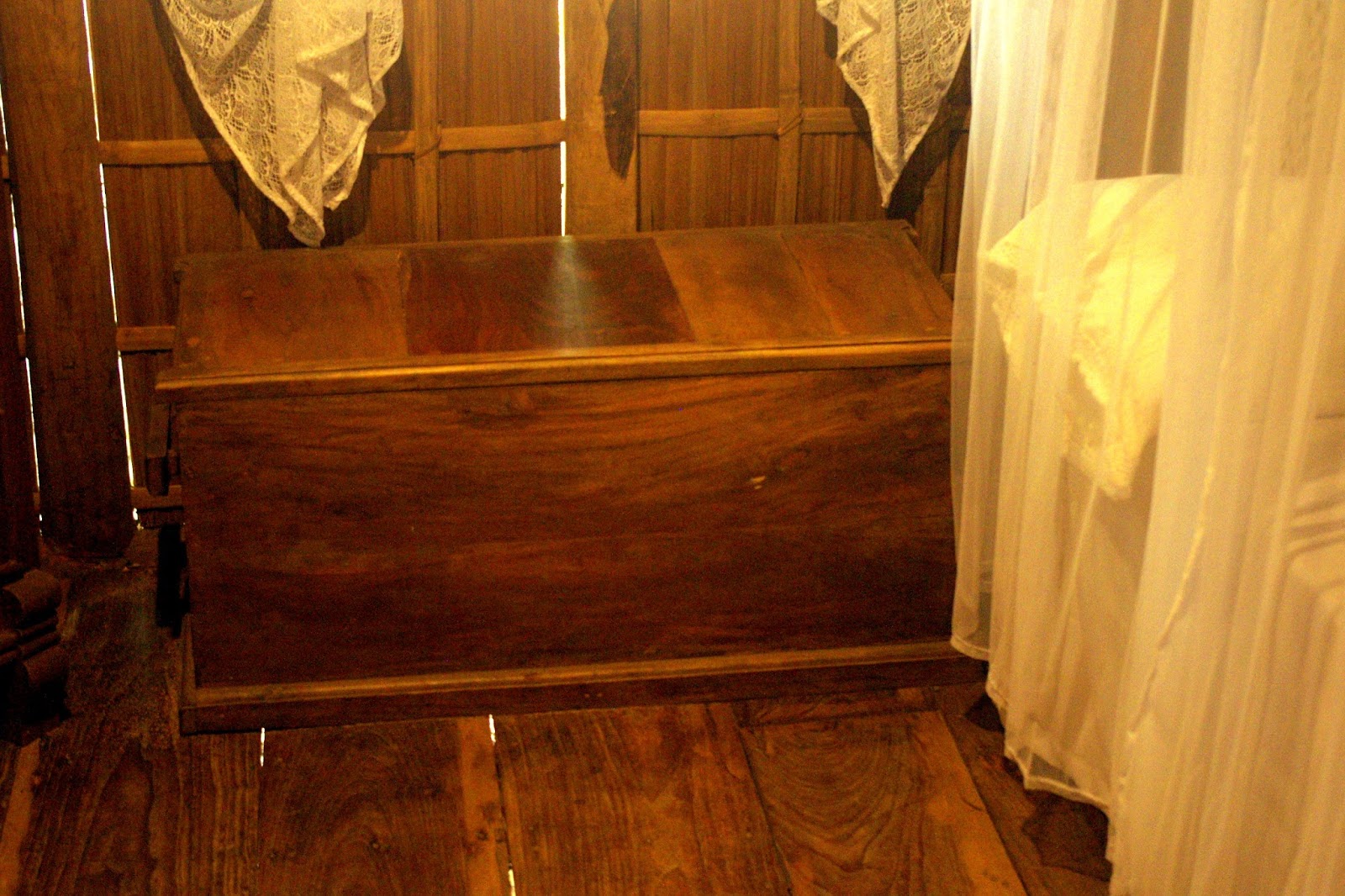
Inside the house is furniture of Spanish colonial era design which is made of indigenous hardwoods. In the living room are chairs and a center table. The seat of the chairs and the top of the table are made of woven rattan that is attached to the wooden frames. There are two chests in the sides of the wall. Outside the only room is an empty book shelf, a wooden wall mounted hooks, a work table and chair and a set of two chairs with a small round table.


In the bedroom is a double sized four poster bed with mattress and white curtains around it. By the bed is a chest and a chair in the corner of the room. There is a cabinet with a mirror on one of its doors and a dresser with a small mirror on top. A chair with a raised seat pairs the dresser.


The cottage for the kitchen is outside the house. There is a stove and the kitchen utensils composed of pots and pans that are made of clay. A pipe of bamboo is reached to the sink.


Aside from the casa residencia, or the residential house, faithful replicas of the original structures which Rizal built are also reconstructed. There is the casitas de salud, a pair of two huts, one for male and the other for female that served as a dormitory for out of town patients. There is the casa redonda or round house. This cottage on stilt is not round but rather octagonal in shape.  It was there that Rizal conducted an eye surgery on George Taufer, the adoptive father of Josephine Bracken and on Doña Josefa, his mother. There is the Casa cuadrada or square house which was built as a workshop and secondary dormitory for Rizal’s students. And there is the chicken coop or hen house which perched on a slope near Rizal’s house.

Casitas de Salud
Casa Redonda

Related posts:

Saturday, March 26, 2016

The Resurrection, a Testament to the Divinity of Jesus

The Resurrected Jesus by Noel Coypel
The resurrection of Jesus is one of the most compelling doctrines of the Christian faith. According to this doctrine, Jesus, by rising from the dead, gave humanity hope of life after death in the kingdom of heaven. Without the resurrection Christianity would not have taken its roots after the death of Jesus on the cross.                                                                                                                                                                            
Jesus was the son of a carpenter named Joseph and Mary who the Bible said divinely conceived Jesus. Little was said about Jesus in his early childhood until he started his ministry in his 30’s. He organized 12 disciples in accordance with the 12 tribes of Israel. He preached in Capernaum and Bethsaida proclaiming the advent of the kingdom of God. He also helped those who were poor in physical resources and spirit and emphasized that moral sincerity was more important than strict adherence to Jewish rituals. Although he was appreciated by the common people, Jesus incurred the enmity of the priests because of his teachings. They thought that his activities might lead the people stray from the laws of the Torah, and that his’ influence to the people might prejudice the Jews’ relationship with their Roman administrators.

Jesus’ claim that he was the Son of God was not favorably received by some people. When words about it reached the ears of the priests and the Supreme Jewish Council, they conspired to kill him.  They bribed Judas Iscariot, one of the disciples of Jesus to betray him for 30 pieces of silver.

During the feast of the Jewish Passover, Jesus gathered his disciples for their meal. He blessed the unleavened bread and said that it was his body and the wine his blood. He told his disciples to follow what he did for his memory. In that occasion he told them of his coming death, and that one of them will betray him. Disturbed, his disciples individually asked if it was he who would betray him. When it was Judas turn to ask that question Jesus answered in the affirmative.

After the meal Jesus and his disciples retreated to the Mount of Olives to reflect and pray. There, he told them of his resurrection. They also went to the Garden of Gethsemane where later a group of people led by Judas Iscariot came. With a kiss, Judas handed Jesus over to the Jews. Jesus was brought to Annas, the father-in- law of Caiaphas, the high priest.and then to King Herod. Finally, he was made to face the high priest and the Supreme Council of the Jews for trial. When the high priest asked if he was the son of God and the Messiah, he admitted it. And the high priest then rent his vestment and said that there was no need for more evidence to prove Jesus’ guilt. And then they sentenced him to death for blasphemy.

Since only the Roman procurator had the power to impose capital punishment, they brought Jesus to Pontius Pilate. Not convinced of the truthfulness of the accusation against him, Pilate asked him if he is the King of the Jews. Jesus’ affirmative reply only aggravated his situation further. Unable to get him off the hook and concerned that the Jews might riot if he would not give the death penalty, Pilate made the last proposition for the Jews to choose between the criminal Barabbas and Jesus for the execution. But the people overwhelmingly demanded the blood of Jesus. Pilate then released the criminal from prison, washed his hands, and handed Jesus to the Jews.

While Jesus was consigned to his doomed fate, Peter, one of his most trusted disciples, watched from a distance. Then a woman asked him if he knew Jesus. Peter made a denial. After a while, another woman and later a man asked peter about Jesus, and he denied again knowing him. On his third denial a cock crowed and Peter remembered what had Jesus told him about that incident. Overwhelmed with a sense of guilt, Peter cried and stayed away from the place.

In the hands of his tormentors and executioners Jesus was whipped, beaten up, spat upon and ridiculed. They mocked him by putting on a crown of thorns on his head, a red cape on his back and handed to him a scepter of reed as “symbols or royalty”. On the top of the cross was the charge against him written on a wooden slab which read: “This is Jesus the King of the Jews”.  Jesus was made to carry his own cross all the way to the place called Golgotha. There, he was crucified together with two robbers whose crosses were at his sides. Even while Jesus was already suffering from great pain on the cross his tormentors continued to mock him saying that if he was truly the Son of God, he would save himself from death. “If he could save others, why couldn’t he save himself?”, a Jew said. While Jesus was on the cross darkness engulfed the land and when he died there was an earthquake. The veil of the temple was rent, and the wall cracked. A Roman centurion who was watching Jesus commented that he was truly the Son of God.                                                                                          
Since the following day was Sabbath, Joseph of Arimathea, a wealthy man who was one of Jesus’ followers, asked Pilate for the body of Jesus to be laid to a tomb belonging to Joseph’s family, and he was granted with the request. On the other hand, the high priest and the Pharisees, concerned that Jesus’ followers might steal his body because of his statement that he would rise three days after his death, went to Pilate and told him about it.  Pilate assured them that guards would be posted to keep watch of the tomb within that period. 

On the third day of Jesus’ death, Mary Magdalene and Mary the mother of James went to tomb to anoint his body for burial. Getting there, they were surprised to find out that the stone covering the sepulcher was gone and so too were the Romans soldiers who were guarding the tomb. When they entered the sepulcher they saw inside a young man and the linen that was used to wrap Jesus’ body.  The mysterious young man told them that Jesus had risen.
                                                    
Meanwhile, the soldiers who were shaken with what they had witnessed told the high priest of the incident at the tomb, and the high priest and the Supreme Council of the Jews then bribed them to tell people that the followers of Jesus stole his body.

As they were about to go to Galilee, the women met the risen Jesus. They hold him by the feet and worshiped him. The women later told the eleven disciples about the resurrection of Jesus. But some of them were doubtful of the report. On that same day as the disciples were gathered Jesus suddenly appeared to them and showed his wounds on the cross. He touched them and ate bread and drank with them. After the meal he suddenly disappeared.

Thomas one Jesus’ disciples who were not around at his first appearance doubted the claim and said that what they saw might just be a spirit. Then on one occasion where the disciples were gathered Jesus suddenly appeared even if the door was closed. He then told Thomas to come forward and touched his wounds. Thomas obeyed and did as he was told and then knelled before him and called him "my Lord and my God". On the 40th day after Jesus death, he appeared for the last time to his disciples and he ascended to heaven.

The disciples’ obedience to Jesus words is their testimony that he was the son of God who was resurrected from the dead. Armed only with their convictions they were able to gain many followers who believed in Jesus. They converted to the new faith not only the Jews but also Greeks, Romans, Arabs and other nationalities.

The Romans saw the early Christians as a threat to their traditional polytheistic faith so that they persecuted them to nip their new faith in the bud. Some Roman officials believed that if the new faith was not divinely inspired it would just wither away with the passing of time. But the new faith founded by Jesus and propagated by his disciples and followers wouldn’t go away and gained more and more new adherents instead. Despite the repression of the early Christians, the people in the Roman Empire were converted to the new faith. Christianity spread like wildfire, and the greatest power on earth at that time, the Roman Empire, could not even prevent its advance despite mustering its available strength to stop it.

Christianity may have died simultaneously with the death of Jesus. The sight of him claiming to be the Son of God who was helpless to the humiliation, torture and abuses of his tormentors disheartened his disciples. His chief disciple, Peter even denied him and the others abandoned him and hid in fear of their lives. However, when Jesus was risen their fear turned into courage and commitment to follow him. Disregarding persecution, and death, and guided by the Holy Spirit, they followed what was told to them by Jesus. The disciples had no power and had no comfort or material resources to offer to people who would only be subjected to harassment and sufferings for their being identified with them. And yet, people believed in them and converted to the new faith. Jesus had told his disciples of his resurrection three days after his death. If this did not happen they would have thought that what he had said and taught were false. Although there are people who will die for a lie which they sincerely believe to be true, people will not die for something that they personally know to be false especially if they do not gain anything for doing so. The disciples personally witnessed the resurrection of Jesus, and that is why they were willing to become martyrs for their faith.

The resurrected Jesus was not the same mortal Jesus that the disciples used to be with before the crucifixion. Like a spirit, the resurrected Jesus could appear all of a sudden in a place, disappear just anytime, and enter a closed door. But he was not a spirit because he talked to the women and his disciples, ate with them and had physical contact with them. His actions are not that of a man or a spirit. It’s an affirmation of Jesus' claim that he is the Son of God. His death is a conclusion of the mission given to him by his father as foretold by the prophets many years before he was born. 

Sunday, March 20, 2016

Dracaena Fragrans (Corn Plant)


Dracaena fragrans or corn plant is one of the more than 100 species of the genus dracaena that is grown as an ornamental plant. The original dracaena fragrans has solid green leaves. There are cultivars with variegated leaves. The dracaena ‘massangeana’, the most common, has a yellow stripe that runs through the center of each and every leaf.  Another variety, the dracaena fragrans ‘lendinii’, has yellow stripes that are on the margins of the leaves rather than in the center. The plant has a long and narrow leaf and clustered small pale yellow flowers that turn white in full bloom. The plant grows like a sugar cane or a palm in a sense that older leaves come off leaving the trunk bottom smooth. Unlike a palm the upper trunk of the corn plant will branch off. However, the branches that develop are scanty.


Growing outdoors, the plant will flower. But dracaena fragrans is only a seasonal bloomer. In a tropical area, it only flowers once a year especially in the month of March. Its small clustered pale yellow flowers are not attractive enough to look at. Their redeeming characteristic is their scent. In the evening the flowers emit fragrance that radiate through its vicinity. In the house it creates a sweet smelling ambiance. This fragrance can be smelled only in the evening and early dawn. The scent is less intense during the day so that the flowers seem odorless during that period.                                                                                                                           

 A good thing about this plant is that it can naturally remove toxic gasses in the air such as formaldehyde, xylene and toluene especially if it is planted on pots and is placed indoors. The NASA Clean Air Study listed Draecena as one of the 15 plants that can improve indoor air quality. In an indoor environment the plant rarely flowers. It can be propagated through its cuttings.

Sunday, March 6, 2016

Snake Plant, a Natural Indoor Air Purifier


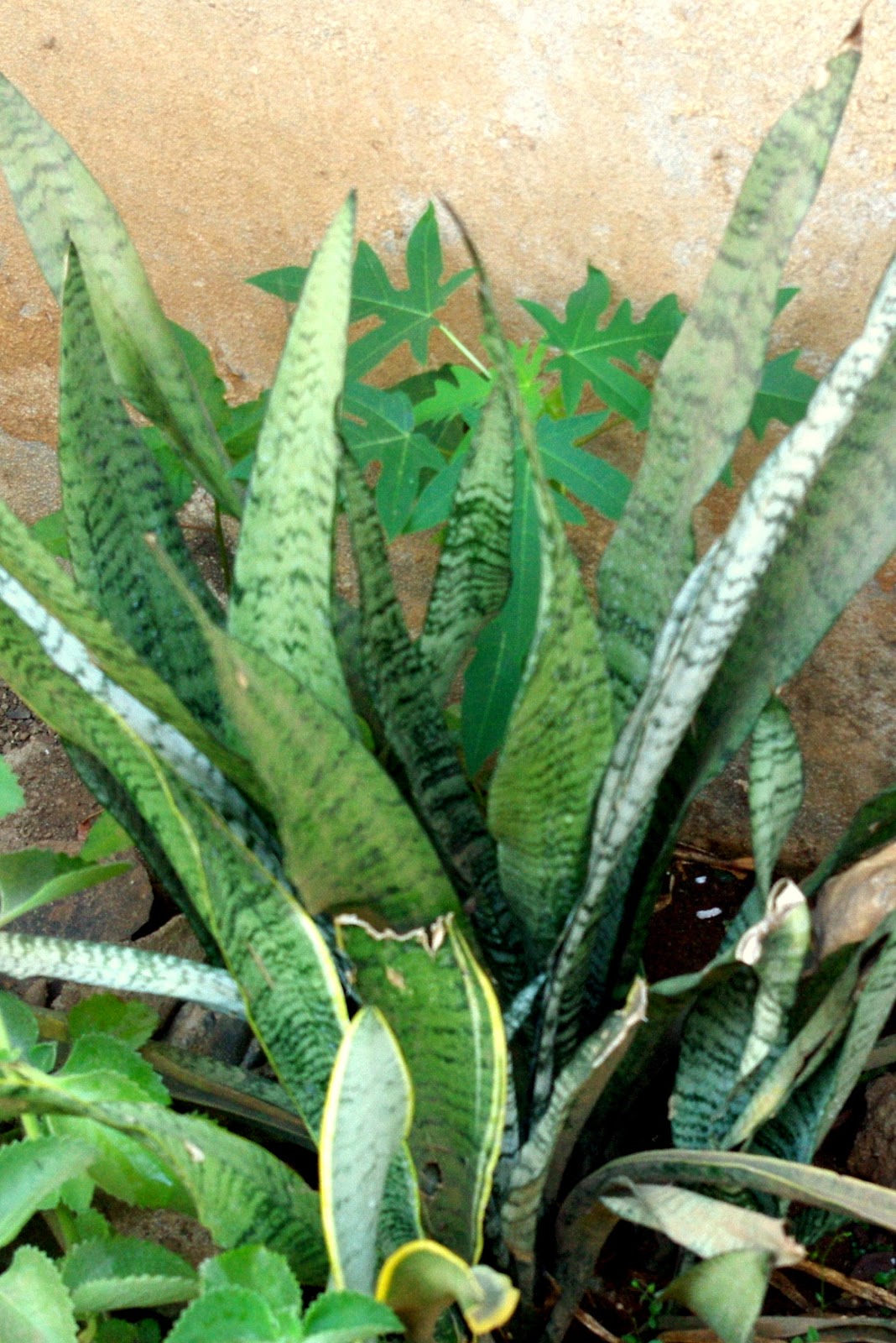
Sansevieria  Trifasciata  or snake plant or mother-in-law’s tongue is an evergreen perennial ornamental plant. The sword shaped leaves are colored light green with streaks of dark green all over the blade. On the margins of a leaf is a yellow vertical stripe, but there are varieties that don’t have such stripe. A leaf usually measures 28-35 inches long and 2-2.4 inches wide.  

                           
Listed by NASA as one of 12 house plants that can give better quality of air inside a house or a building, snake plant removes toxic gasses by passively absorbing toxins such as nitrogen oxides and formaldehyde. It is unlike most other plants that absorb carbon dioxide and release much oxygen during daytime. Snake plant takes away carbon dioxide and gives off oxygen in the evening. For this reason, it is an ideal ornamental plant inside the house or the bedroom to provide a slight boost of oxygen when one sleeps.


Snake plant can be propagated by cutting or dividing its rhizome. It is mostly planted on the ground or in pots with free draining soil. It can survive with less sunlight and water. Overwatering can cause the roots to decay which may kill the plant.